


Call Us
+86-15957735002
Email Us
gaohang@yagect.com

How Do Flat Cable Clips Improve Cable Routing Efficiency?
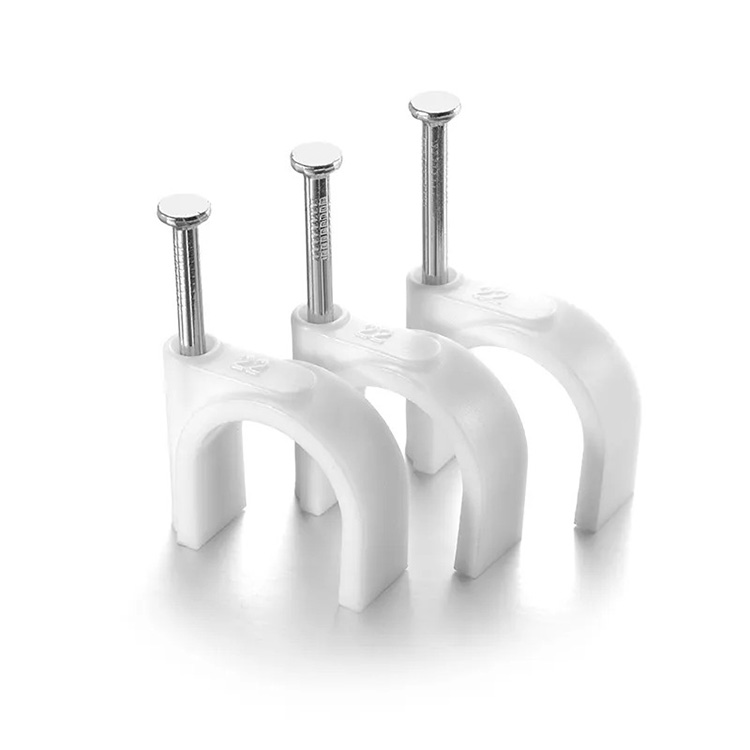
Flat cable clips are specialized fasteners engineered to secure low-voltage and data cables along walls, baseboards, and structural surfaces with minimal visual footprint. Their design emphasizes streamlined installation, stable holding force, and compatibility with flat cable profiles commonly used in telecommunications, home entertainment systems, networking infrastructure, and electrical layouts.
How Do Flat Cable Clips Ensure Precision Cable Management?
Flat cable clips maintain cable alignment by combining controlled clamping tension with surface-stabilizing geometry. Their flattened retention channel distributes pressure evenly across the cable sheath, preventing deformation while eliminating slack that can lead to signal interruptions or premature wear. The nail or screw fixture anchors the clip securely to the mounting surface, keeping cable runs consistently linear and reducing the risk of tangling, snagging, or detachment under external force.
The product’s engineering emphasizes dimensional accuracy, consistent grip force, and material endurance. Below is a consolidated technical reference showing standard parameters commonly offered in the Flat Cable Clips category:
| Parameter Type | Specification Range | Description |
|---|---|---|
| Clip Material | PE, PP, Nylon 66 | UV-resistant, flame-retardant options depending on environment |
| Nail Type | Hardened steel / zinc-plated steel | Corrosion-resistant fastening for wood, masonry, and drywall |
| Clip Sizes | 4 mm – 14 mm (width), 5 mm – 20 mm (height) | Accommodates Ethernet, fiber, speaker, and low-voltage flat cables |
| Operating Temperature | -10°C to 90°C | Thermal stability for indoor and moderate outdoor use |
| Color Options | White, Black, Gray | Matches interior or surface requirements |
| Fixing Mode | Side-entry nail, top-entry nail | Selected according to cable layout geometry |
| Cable Compatibility | Flat Ethernet, ribbon cable, speaker wire, LED strip wiring | Suitable for commercial and residential routing |
These parameters are foundational for determining clip-to-cable fit, installation durability, and layout stability in high-density cabling spaces.
How to Select the Right Flat Cable Clips for Different Installation Scenarios?
Choosing the correct clip requires evaluating cable type, surface material, environmental exposure, and intended load distribution. In structured wiring or network deployments, precision in clip selection directly impacts signal reliability, installation speed, and long-term maintenance costs. Several considerations are typically prioritized:
Cable Geometry and Tension Control
Flat cable clips must match cable width and thickness precisely. Undersized clips compress the cable sheath excessively, potentially causing signal degradation or premature insulation fatigue. Oversized clips allow excessive play, increasing the risk of cable drift and misalignment. Installation guidelines recommend a retention fit that maintains slight contact without distortion.
Surface Material and Fastening Method
For wooden or drywall surfaces, hardened steel nails provide efficient anchoring. In masonry environments, pre-drilled holes may be required, followed by screw-type flat clips for optimal grip strength. High-humidity environments often demand corrosion-resistant hardware to prevent long-term oxidation.
Routing Path Requirements
Routing paths vary between straight runs, corner transitions, and multi-line arrangements. Flat cable clips designed with tight corner-radius handling help maintain cable integrity when running along edges or architectural contours. Multi-clip bundles may be used for parallel data lines to avoid signal cross-interference.
Environmental Exposure and Load Factors
When wiring near heat sources or in semi-outdoor spaces, temperature-resistant polymers ensure the clip maintains tension without brittleness or warping. If cable bundles shift due to vibration or foot-traffic pressure (e.g., behind entertainment furniture or under desks), clips with reinforced nail penetration improve load retention.
Through a holistic evaluation of these variables, flat cable clips become not only functional cable keepers but precision tools enabling orderly, safe, and standards-aligned wiring structures.
How Are Flat Cable Clips Evolving to Meet Future Cable-Management Demands?
As networking, smart-home systems, and high-speed data systems expand, cable-management solutions are required to balance functionality with aesthetics and long-term reliability. Flat cable clips are undergoing notable material, geometric, and application-oriented developments to support these changes.
Expansion of Smart-Home Cabling Requirements
Future smart-home configurations rely on dense clusters of low-voltage cables for sensors, security cameras, IoT modules, and distributed audio systems. Flat cable clips designed with higher dimensional tolerance and vibration-resistant fastening support these complex multi-cable ecosystems.
Enhanced Materials for Stability and Environmental Safety
Polymer advancements are driving clips toward higher tensile strength, greater UV stability, and improved flame-retardant properties. These upgrades support longer service life and compliance with increasingly stringent building-safety standards.
Integration Into Structured Cabling and Workspace Design
Modern office layouts incorporate concealed wiring pathways that accommodate both power and low-voltage lines. Future iterations of flat cable clips may prioritize ultra-low-profile designs that integrate smoothly into minimalist wall channels, baseboard conduits, and modular furniture.
Support for High-Bandwidth Cabling
As gigabit-class and fiber-based systems become standard, consistent cable spacing and protection become essential. Flat cable clips with enhanced clamping geometry reduce micro-bending risk for sensitive cables such as flat optical fibers or high-frequency signal lines.
These developments underscore an ongoing shift toward clips that offer not just mechanical stability but also alignment with evolving architectural, digital, and safety expectations.
How to Install Flat Cable Clips Correctly for Maximum Stability?
A structured installation process ensures that cable runs remain secure, uniform, and compliant with recommended safety standards. Precise installation also minimizes the risk of cable damage and eliminates redundancy in maintenance cycles.
Pre-Installation Assessment
Evaluate cable length, routing path, and surface quality. Determine whether the installation will occur on wood, drywall, metal, or concrete. Verify clip size relative to cable width and consider environmental conditions such as temperature or moisture.
Measuring and Aligning the Routing Path
Use a straight edge or chalk line to mark cable paths. This ensures that all clips align evenly and prevents crooked routing lines that can reduce aesthetic appeal or cause cable stress.
Fixing the Clip
Position the flat cable within the clip channel without twisting or compressing it. Hold the clip flush against the surface and drive the nail or screw in at a perpendicular angle to ensure maximum holding strength. Maintain consistent spacing—typically 30–50 cm, depending on cable type and tension.
Testing the Installation
After fastening, lightly pull the cable to ensure the clip provides adequate resistance without excessive compression. Verify the route for any tight bends, pinch points, or stress zones.
Maintenance and Inspection Practices
Inspect clips periodically for wear, loosening, or discoloration. Replace any clips showing deformation or weakened retention, especially in high-humidity environments.
Common Questions About Flat Cable Clips
Q1: How should the correct clip size be determined when working with various flat cables?
A1: Clip size should match the cable’s width and thickness closely. Measure the cable’s dimensions and choose a clip offering a snug but non-compressive fit. A clip that is too small may deform the cable sheath, whereas an oversized clip can result in cable movement or structural instability. Precision measurement ensures optimal tension distribution and long-term cable integrity.
Q2: How far apart should flat cable clips be placed during installation?
A2: Spacing typically ranges from 30 to 50 centimeters, depending on cable flexibility, weight, and installation environment. Heavier cables or high-traffic areas may require shorter spacing intervals for added stability. The guiding principle is consistent tension management: clips should prevent sagging without introducing compression stress.
Flat cable clips provide structured, reliable, and efficient methods for routing modern low-voltage and data cables. Through controlled clamping force, precise dimensional compatibility, and refined installation practices, these clips support robust cable-management frameworks across residential, commercial, and industrial environments. Their evolutionary trajectory continues to align with the expanding demands of high-speed data networks, smart-home ecosystems, and aesthetically driven interior design standards.
YAGE offers production-grade flat cable clips engineered for stability, accuracy, and performance across a wide range of cabling scenarios. For inquiries, specification support, or procurement guidance, contact us to discuss how these solutions can support your cable-management requirements.
Send Inquiry



X
We use cookies to offer you a better browsing experience, analyze site traffic and personalize content. By using this site, you agree to our use of cookies.
Privacy Policy
News
 How to use cable ties on wires?2024/12/24
In the field of electrical work, organization and safety are crucial. One of the simplest but most effective tools to achieve these goals is zip ties. Cable ties (often referred to as ties) are known for their versatility and ease of use, and are essential in both professional and DIY electrical pro......
 Nylon cable tie maintenance tips!2024/11/12
With the development of society, the application of nylon cable ties has also expanded, and it can be seen everywhere in all walks of life. However, driven by interests, the quality of its products is also different. How to choose good quality still requires consumers' sharp eyes. Here are a few tip......